Chain of causes ~ damage according to ISO 14971


Medical devices can lead to one Harm for patients, users or third parties. Manufacturers must determine this harm in order to evaluate and control the risks posed by their products.
This article provides assistance in determining and documenting damage in accordance with ISO 14971 and in correctly using the term “damage”.
1. Definition
ISO 14971 defines the term damage.
“Injury or damage to human health or damage to property or the environment”
DIN ISO 14971:2022, chapter 3.3 with reference to ISO/IEC 63:2019, 3.1
Damages according to ISO 14971 are usually:
- impairments of Body structure (e.g. cut, burn, broken bone)
- impairments of Body function (e.g. ability to move, see, ability to purify blood).
- Reduction in life expectancy
- Psychological disorders
The latter are only included in damages of the third edition of ISO 14971. Previously, damages were limited to physical injuries and damages.
In this episode of the podcast Christian Rosenzweig and Christian Johner give tips for accurately managing terms such as danger, dangerous situation and harm. This helps create accurate, standards-compliant risk management files more quickly and without unnecessary discussions.
You can also find these and other podcast episodes here.
According to ISO 14971, damage also includes damage to property or the environment. They also include financial damages.
It is usually not useful to evaluate damage to property or the environment with the same risk acceptance matrix as damage to health. Because this would presuppose that the severity of these damages is comparable. For example, the manufacturer should equate fatal damage to a sum of money.
2. Typical errors in determining damages
Mistake 1: Assuming there is one (single) damage
Many manufacturers suspect it is A There is damage, which you must enter in the appropriate column of the “risk table”. This is usually not true. Because there is not just one type of damage, but rather an entire chain of damage, where every single link represents damage in the sense of the definition (see fig. 1).
Each element of this chain of causes meets the definition of ISO 14971. Because each element represents a physical injury or damage to health.
Each element of this damage chain will occur with a different probability and will therefore represent a different risk under ISO 14971.
Mistake 2: assuming the “linearity” of the damage chain
These causal chains are generally complex and non-linear as shown in Figure 1. This is made clear in Figure 2:
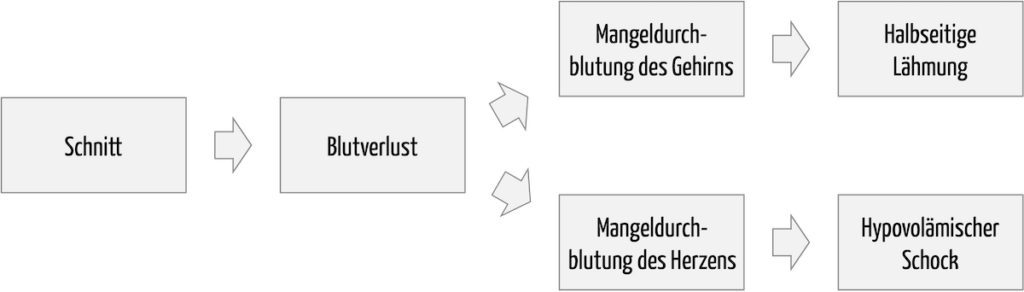
If you want to conduct a risk analysis, specifically looking at this last part of the cause chain, you need to
- a doctor AND
- A Risk managerdocumenting that physician’s findings in the risk management file in a manner that is consistent and compliant with the requirements of ISO 14971.
Mistake 3: Indicating damages that are not damages
In the column entitled “Damages” of the risk table the following items are regularly found:
- Defective product
- Serious adverse event
- Harm to patients
- Expensive repair
Do you recognize the problems? You can find a solution at the end of the article.
Mistake 4: Overlooking the damage
Identifying damage is a hazard or risk analysis task. This analysis must be done methodically.
Damages often “overlooked” are those caused by:
- Application error
- Predictable abuse
- Other intended use, e.g. storage, transportation, cleaning
- Production
- Failure to achieve the intended purpose, e.g. B. delayed or incorrect display of laboratory values on an IVD or inadequate removal of substances requiring dialysis from the blood on a dialysis machine
Let us know if you would like support on this: contact us using our contact form.
Error 5: incorrect damage assessment
To determine risks, manufacturers must estimate the likelihood and severity with which damage will occur.
3. Conclusion
If you want a stable basis for a reliable, ISO 14971 compliant risk management file, you need to use terms like harm precisely. This also includes knowing and avoiding the mistakes mentioned above. Competent risk management teams do this best.
Change the history
resolution
| Entry in the “Damage” column | Comment |
| Defective product | A defective product would theoretically be damage to the goods and therefore damage within the meaning of the definition of ISO 14971. However, the description “defective product” should first be described in more detail and then it would be decided which category it falls into. Examples: – “Defective product” in the sense of malfunction or complete failure of the product (lack of availability of the product for urgent diagnostic or therapeutic use) – This would be the defective product no damagebut a hazard that can then cause harm to the patient (e.g. hypoxia or death if a civil service machine is defective during operation) – “Defective product” in the sense of a housing with sharp edges due to breakage of the material – the defective product would also be here no damagebut a danger. Possible harm to the user, patient or third party would be, for example, a cut injury – The “Defective Product” in the sense of only economic damage to the product itself is not taken into consideration by the Ras risk management according to ISO 14971. |
| Serious adverse event | This damage is too nonspecific. “Severe” corresponds to a level of severity. This needs to be documented in another column. |
| Harm to patients | This damage is described too vaguely. It is not enough to specify who will suffer the damage. |
| Expensive repair | See comment on “Defective product”. Equating economic damage to health damage is ethically difficult. It is therefore better to evaluate these “types of damage” in different risk acceptance matrices. |
Similar posts
Medical devices can lead to one Harm for patients, users or third parties. Manufacturers must determine this harm in order to evaluate and control the risks posed by their products. This article provides assistance in determining and documenting damage in accordance with ISO 14971 and in correctly using the term “damage”. 1. Definition ISO 14971…