STED (Summary Technical Documentation) and ToC (Table of Contents): how useful is it


It’s the STED (Summary Technical Documentation) and their successors ToC (summary) the solution for medical device manufacturers who need to have their products approved internationally?
This article presents the STED or ToC and therefore a suggestion on how manufacturers can structure the technical documentation.
1. STED: a brief introduction
a) Why STED/ToC can be useful
The requirements of different legal systems (e.g. Europe, USA/FDA, China, Japan, Canada, Brazil, etc.) for the approval of medical devices differ. But all approval procedures require technical documentation.
Unfortunately, both the content and the structure of these files differ, which means that internationally active medical device manufacturers have to compile the technical documentation several times. This work is not very valuable.
b) How STED and ToC were born
This is also why committees composed of representatives of authorities and manufacturers, such as the Global Harmonization Task Force (GHTF), have been formed to develop proposals for standardized technical documentation. One result was this “Summary technical documentation to demonstrate compliance with the Essential Principles of Safety and Performance of Medical Devices (STED)” the GTF (FINAL IMDRF/RPS WG/N9:2018).
The documents are now no longer on the GHTF website, as the GHTF has been replaced by the International Medical Device Regulators Forum IMDRF. STED offers it under the name “Non-in vitro diagnostic device”.
Regulatory Submission Table of Contents (nIVD ToC)” to download (now in the fourth version from June 2024). There is a corresponding model for in vitro diagnostics.
In publications the IMDRF talks about “nIVD MA ToC”, i.e. the summary for non-IVDs. There is an analog ToC for IVD.
c) Regulatory context
The GHTF or IMDRF is made up of representatives of state authorities and legislators; However, the publications have no legal value. They are recommendatory but not binding.
However, manufacturers are required to meet regulatory requirements for the content of the documentation. These include, among others:
- Identification (e.g. UDI) of the product
- Description of the product, its variants, configurations and accessories
- Intended purpose including characterization of patients (indications, contraindications), users and environment of use
- Labeling, e.g. B. Instructions for use, packaging
- Information on development and production
- Evidence of all legal requirements (typically through testing) for safety, sterility, electromagnetic compatibility, biocompatibility, etc.
- Information on the quality management system
2. Documentation structure according to ToC
a) Overview
The ToC format structures the technical documentation into over 150 chapters and subchapters. The first level of the chapter provides an overview (see Fig. 1) and clarifies that not only the product but also the quality management must be documented (depending on the country and approval procedure).
The chapters are:
- Regulatory: Regulatory and market-specific documents can be found here.
- Submission context: Product description can be found here.
- Non-clinical evidence, e.g. B. Laboratory tests
- Clinical evidence
- Labeling
- QM system: product-specific procedures, methods and specifications
b) Chapter 1: Regional administrative
The first chapter includes all content specific to the respective market or specific approval process. These range from the “Device List” to explanations and “User Fees”.
c) Chapter 2: Context of the presentation
The second chapter of the ToC is entitled “Context of Presentation”. It includes a precise specification of how the product is to be described with its intended use, its variants and the distinction from previous products and similar products.
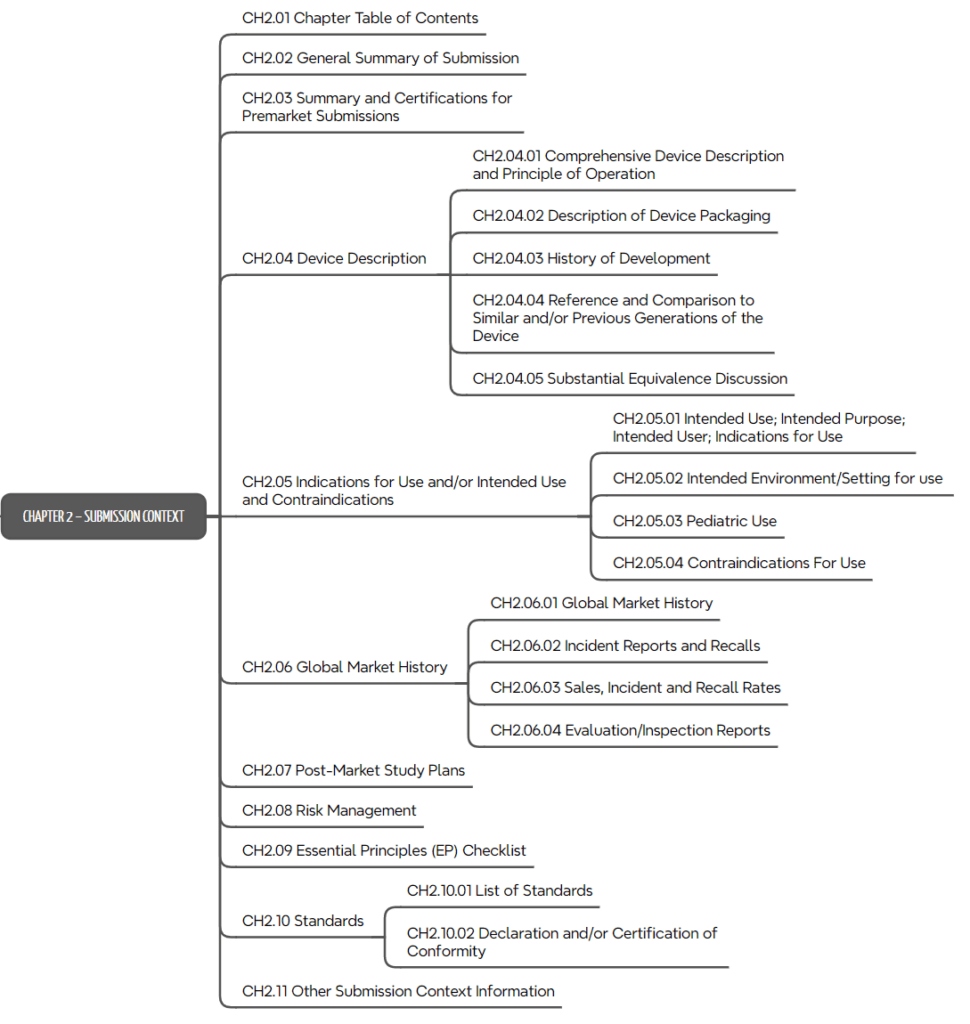
d) Chapter 3: Non-clinical evidence
The third chapter of the ToC is the largest. Specifies evidence of regulatory requirements such as laboratory tests, simulations, software tests, animal experiments, usability studies, etc.
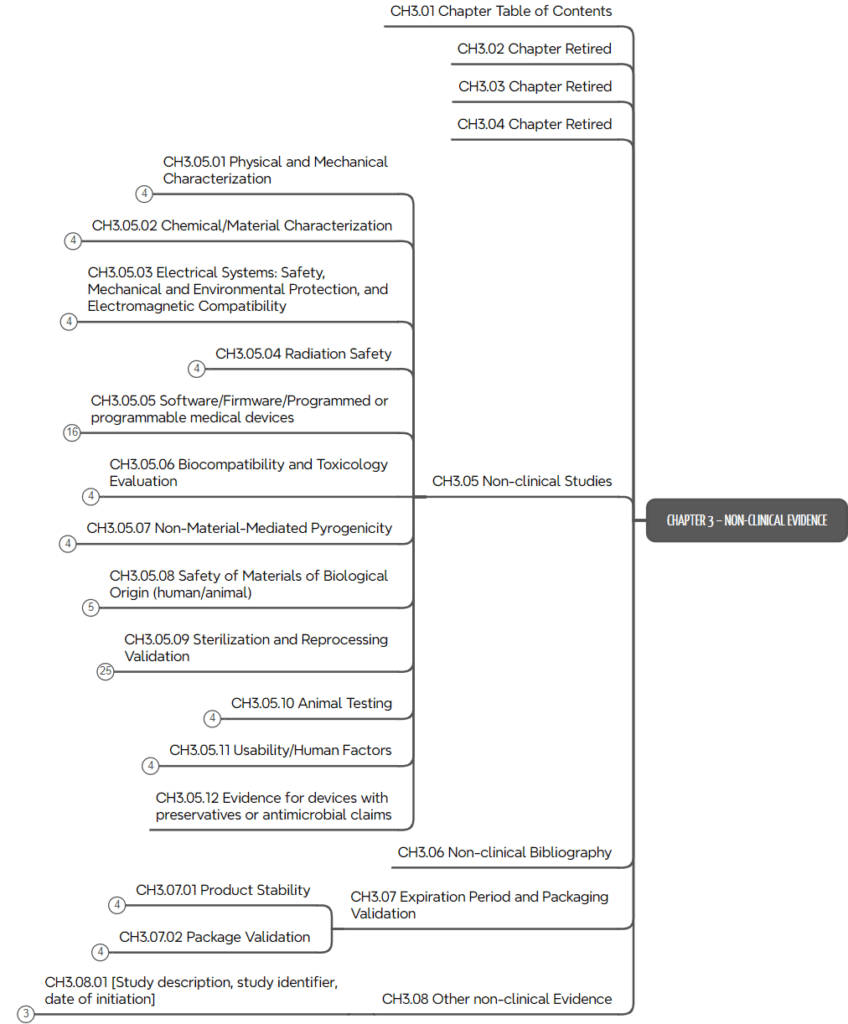
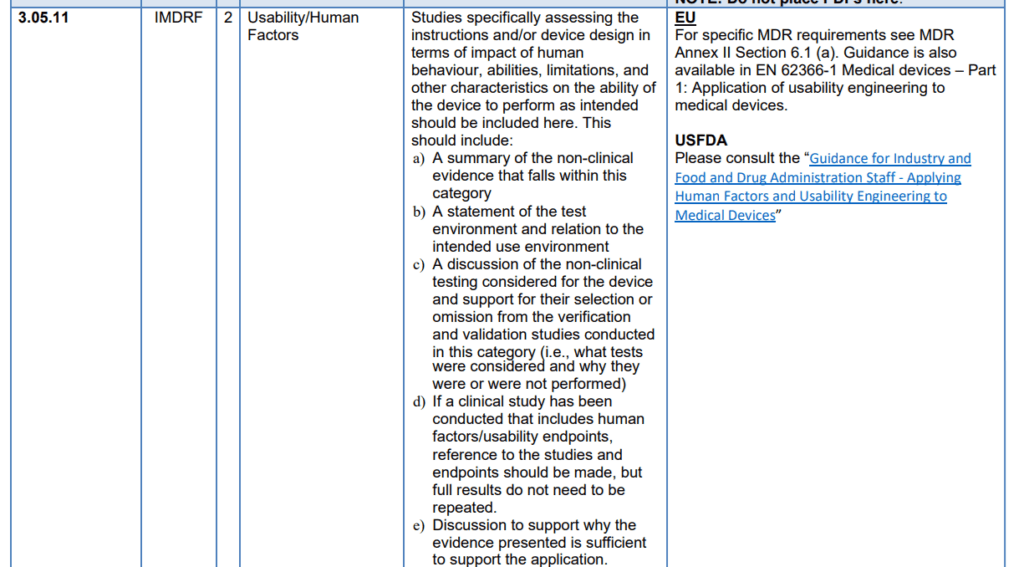
The ToC provides much more than just a chapter structure. It also describes typical content, as shown in Fig. 4 using the example of “usability requirements”.
e) Chapter 4: Clinical evidence
The fourth chapter provides guidelines for both the documentation of clinical evaluation and clinical studies. Compared to MEDDEV 2.7/1 and ISO 14155, these specifications are rather approximate.
f) Chapter 5: Labeling and promotional material
The title of the fifth chapter adequately describes its content. The chapter distinguishes between the different recipients (doctors, patients, technical users). In labeling, a distinction is made between the “labels” on the product, on the packaging and the various instructions, brochures and marketing materials.
g) Chapter 6: Quality Management System
The sixth chapter establishes the requirements for QM system documentation. The ToC distinguishes between general specifications and product specifications. Ultimately, the chapters refer to the individual sections of the ISO 13485 standard.

Do you want to ensure that your technical documentation meets the MDR/IVDR requirements?
Our e-learning course shows you step by step how to create a compliant structure for your documentation. You will learn how to check your documents not only for completeness, but also for consistency and compliance. After completing the course, you will be able to review your documentation and ensure it complies with regulations.
3. STED and ToC in practice
a) A complete summary
The structure of the STED (Summary Technical Documentation) or ToC is very extensive with over 150 chapters and subchapters, so much so that the term “summary” is almost a euphemism.
However, these chapters represent the majority of what a manufacturer needs for a product. Many chapters are not applicable to the specific product: the software does not require discussion of biocompatibility, and animal testing is not necessary for many products.
b) Degree of detail
The extensive 160-page document provides manufacturers with much more than just an overview of what the technical documentation should contain. However, STED and ToC are not and are not intended to be so granular as to make their specifications superfluous.
c) Recognition by the authorities
The FDA is actively working on the further development of STED or ToC. However, with its eSTAR format, it is promoting an alternative path to digital, data-driven approval files. However, it offers a mapping to the ToC in the eSTAR model.
Canadian authorities appreciate STED and its successor ToC. Based on its structure, they published their own idea of the structure of technical documentation. However, Health Canada is now working closely with the FDA and is using the eSTAR format as part of a pilot program.
The Chinese authority NMPA also uses the ToC format or makes it mandatory.
The Japanese PMDA continues to use the old STED format.
d) Conclusion
Die Summary technical documentation (STED) and its successors Table of contents format (ToC) are a valid tool for structuring technical documentation. There are also suitable alternative structures.
It is questionable whether STED or ToC should also determine the structure of QM documents.
Technical documentation in STED or ToC format is no guarantee of successful approval. This requires not only a clear structure, but also complete and correct content.
It’s a shame that authorities around the world haven’t yet managed to agree on a format. However, STED and ToC have already come very close to this goal.
However, we suspect that in the future more and more countries will use the FDA’s eSTAR format for their approval processes.
Change history:
- 2024-10-16: Update based on current ToC model
Similar posts
It’s the STED (Summary Technical Documentation) and their successors ToC (summary) the solution for medical device manufacturers who need to have their products approved internationally? This article presents the STED or ToC and therefore a suggestion on how manufacturers can structure the technical documentation. 1. STED: a brief introduction a) Why STED/ToC can be useful…